
← All articles
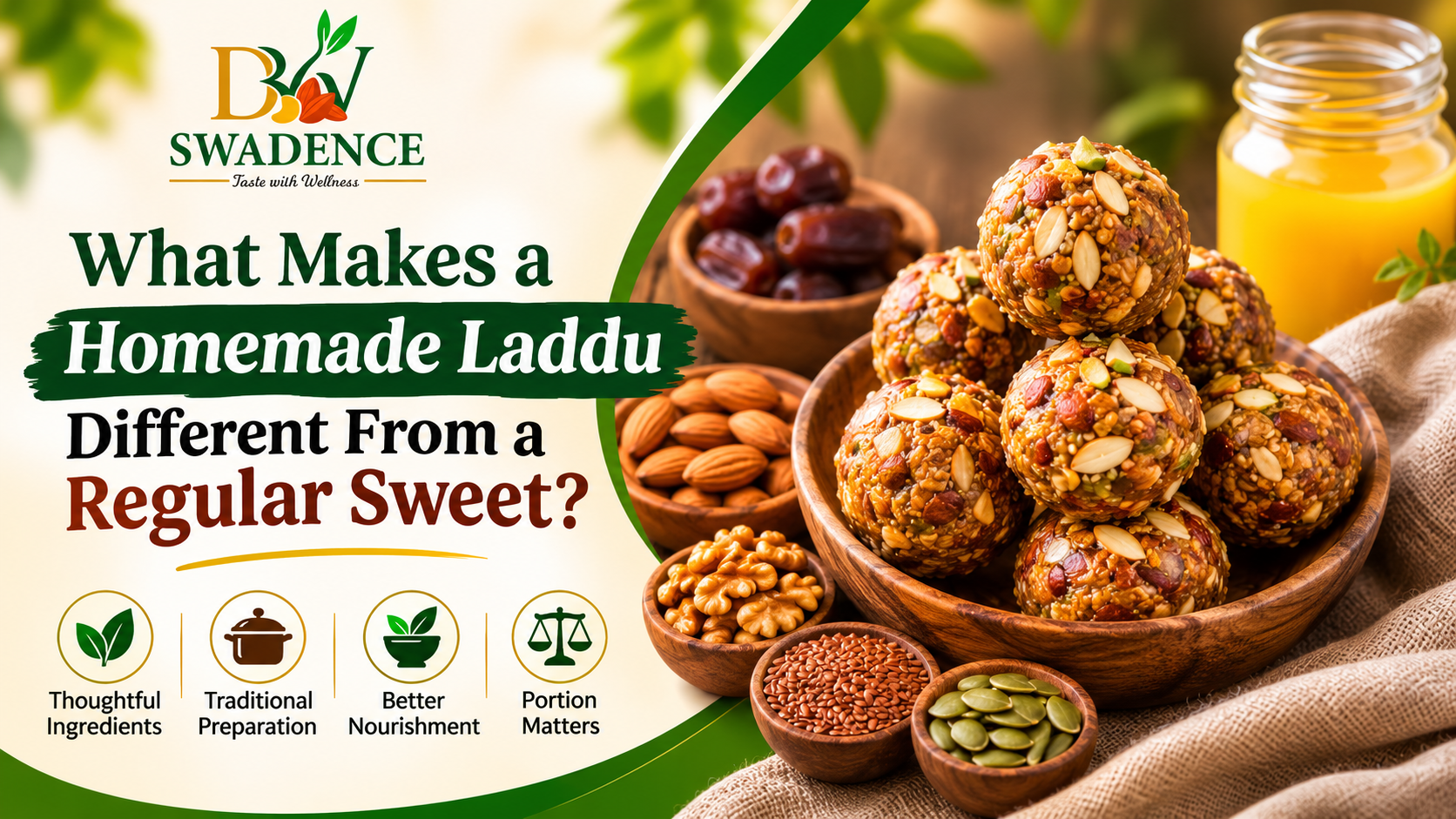
What Makes a Homemade Laddu Different From a Regular Sweet?
What Makes a Homemade Laddu Different From a Regular Sweet?
Laddu is more than just a traditional Indian sweet. It represents generations of culinary traditions, family recipes and the familiar taste of homemade food.
From festive celebrations to everyday nourishment, laddus have always been prepared using ingredients such as grains, pulses, nuts, seeds, ghee and natural sweeteners.
But have you ever wondered what makes a thoughtfully prepared homemade laddu different from conventional sweets?
The difference is not simply about taste or appearance. It is about ingredient selection, preparation techniques, nutritional composition and portion awareness.
Let's explore what makes these traditional treats special.
1. Ingredients: The Foundation of Every Laddu
The ingredients used in a recipe play an important role in determining its nutritional profile.
Traditional homemade laddus can include a variety of ingredients, such as:
- Almonds and walnuts
- Flaxseeds and pumpkin seeds
- Sunflower seeds
- Roasted besan and whole grains
- Pulses and other traditional ingredients
- Ghee
- Dates and raisins
Conventional sweets may use ingredients such as refined sugar, refined flour, khoya and other sweetening ingredients, depending on the recipe.
Neither homemade nor commercially prepared sweets are automatically healthier. The actual nutritional value depends on the ingredients, their quantities and the preparation method.
2. More Control Over Sweetness
One advantage of homemade preparation is the ability to control the type and quantity of sweetening ingredients.
Dates and raisins are commonly used in traditional recipes to provide natural sweetness and distinctive flavour.
Some modern recipes also use monk fruit sweeteners as an alternative to conventional sugar.
However, it is important to understand that natural sweetness does not necessarily mean sugar-free.
Dates and raisins contain naturally occurring sugars and contribute to the overall carbohydrate content.
Understanding the ingredients is always more useful than relying only on labels such as natural or sugar-free.
3. Nutritional Variety Through Nuts and Seeds
One interesting feature of thoughtfully prepared laddus is the possibility of combining different nutrient-rich ingredients in a single serving.
For example:
Almonds: Provide plant-based protein, fibre, vitamin E and healthy fats.
Walnuts: Are particularly known for their alpha-linolenic acid (ALA), a plant-based omega-3 fatty acid.
Flaxseeds: Provide dietary fibre and plant-based omega-3 fatty acids.
Pumpkin Seeds: Contain protein, healthy fats and minerals such as magnesium.
Sunflower Seeds: Provide vitamin E, protein and healthy fats.
When these ingredients are combined in appropriate proportions, they can contribute nutritional variety to a recipe.
However, adding more ingredients does not automatically make a food healthier. Their quantities and overall formulation matter.
4. Traditional Preparation Makes a Difference
Have you ever noticed the wonderful aroma of freshly roasted besan, grains or nuts?
Traditional laddu preparation involves several steps that influence the final taste and texture.
Some common preparation techniques include:
- Carefully roasting grains and flour.
- Preparing and chopping nuts.
- Grinding or blending selected ingredients.
- Mixing ingredients in appropriate proportions.
- Adding ghee to achieve the desired consistency.
- Shaping the mixture into individual laddus.
Each step contributes to the final product.
Proper roasting, for example, helps develop the characteristic aroma and flavour associated with traditional homemade sweets.
This is why preparation techniques are just as important as ingredient selection.
5. The Importance of Ghee in Traditional Recipes
Ghee has been an important ingredient in Indian cooking for generations.
It contributes richness, aroma and a distinctive mouthfeel to traditional preparations.
In laddus, ghee helps bring ingredients together and influences the final texture.
However, ghee is also a concentrated source of fat and calories.
Its quantity should therefore be considered as part of the overall recipe.
Traditional ingredients can be appreciated without making exaggerated health claims about them.
6. Why Portion Size Matters
One common misunderstanding about healthy eating is that nutritious ingredients can be consumed without limits.
Almonds are nutritious. Walnuts provide essential fatty acids. Seeds contain valuable nutrients.
But these foods are also energy-dense.
Consuming large quantities can contribute significant calories to your daily diet.
This is why portion awareness is an important part of everyday food choices.
Instead of eating snacks randomly throughout the day, having a defined serving can make consumption easier to manage.
The right portion, however, depends on individual dietary requirements.
7. Homemade Laddus and Modern Lifestyles
Modern lifestyles often leave people with limited time for preparing traditional foods at home.
Convenience, storage and portion management have become important considerations when choosing everyday snacks.
This has created an opportunity for traditional recipes to evolve into more convenient formats.
Thoughtfully selected ingredients, individual packaging and clearly defined portions can make traditional food preparations easier to incorporate into everyday routines.
The objective is not to replace homemade food but to make familiar food traditions more accessible.
8. The Swadence Approach: Traditional Taste, Thoughtful Preparation
At DB6V Swadence, we believe traditional Indian foods can be presented in a way that complements modern lifestyles.
Our philosophy focuses on:
- Thoughtfully selected ingredients.
- Traditional food inspiration.
- Careful preparation.
- Convenient packaging.
- Defined daily portions.
- Greater ingredient transparency.
The idea behind our 30-sachet concept is simple: one sachet for one day.
It offers a convenient way to manage individual servings without measuring portions every day.
We believe that everyday food choices should be simple, understandable and enjoyable.
Frequently Asked Questions
Q1. What is the main difference between homemade laddus and regular sweets?
The main difference depends on the ingredients and preparation methods. Homemade laddus offer greater control over the recipe, while conventional sweets can vary considerably in their ingredients and nutritional composition.
Q2. Are homemade laddus always healthier?
No. Their nutritional value depends on the ingredients, sugar content, fat content, preparation and portion size.
Q3. Can laddus made with dates be considered sugar-free?
No. Dates naturally contain sugars and carbohydrates, even when no refined sugar is added.
Q4. Why are almonds and walnuts used in laddus?
Almonds and walnuts contribute different nutrients, including protein, fibre, healthy fats and micronutrients. They also improve the flavour and texture of traditional recipes.
Q5. Can laddus be included in a balanced diet?
Yes. Laddus can be enjoyed as part of a balanced eating pattern when their ingredients and serving sizes are considered.
Q6. Why is portion control important when eating dry fruits and nuts?
Dry fruits and nuts are generally energy-dense. Being mindful of serving sizes helps manage overall calorie consumption.
Final Thoughts
A laddu is not defined only by its sweetness. Its ingredients, preparation techniques, nutritional composition and portion size all contribute to the overall food experience.
Traditional Indian recipes have always evolved with changing lifestyles. Bringing thoughtful ingredient selection and convenient portions into familiar food traditions is simply another step in that journey.
At DB6V Swadence, we celebrate the familiar taste of traditional Indian food while embracing a more thoughtful approach to everyday choices.
DB6V Swadence – Taste With Wellness.